
What to Expect During TMS Therapy, From Consultation to Final Session
Dr. Jamie Rogers • October 29, 2026
Quick Summary
Your TMS path at a glance
-
Step 1
Free consultation
We review your history and medications, you complete four short forms, and insurance paperwork begins. No treatment that day.
-
Step 2
Mapping visit
Your first session, about an hour. We find your treatment spot and the right pulse strength for your brain.
-
Step 3
Short sessions
Several days a week. Stimulation runs about 20 minutes on a standard protocol, or a few minutes on some newer ones.
-
Step 4
Full course
About 30 to 37 sessions over roughly six to ten weeks, with your exact plan set by your physician.
- Awake the whole time
- No anesthesia or sedation
- Drive yourself home
True North Integrative Mental Health is a psychiatric and TMS clinic in Greenville, NC, led by Dr. Jamie Rogers, with TMS treatment overseen by our Medical Director, Dr. Marion Wright.
TMS therapy follows a clear path: a free consultation and some paperwork, a longer first visit where we map your treatment spot, then short sessions several days a week for roughly six to ten weeks. You stay awake, feel a light tapping on your scalp, and can drive yourself home afterward.
Knowing each step ahead of time makes it easier to plan treatment around work, school, and family. Below, we walk through every stage of our
TMS therapy program in Greenville, what each visit feels like, and how to prepare so your first week goes smoothly.
What Happens at a TMS Consultation?
The consultation confirms whether TMS is a safe and appropriate fit for you, and it starts the insurance paperwork. There is no treatment that day. We talk through your symptoms, your history, and the medications and therapy you have already tried, then answer your questions about the process.
Before or during the consultation, you will complete four short sets of paperwork:
- Adult TMS Registration. The TMS registration form asks for the same details your insurance company requires for prior authorization, so the more complete it is, the faster your approval can move.
- TMS Exclusion Criteria. A checklist of implants and devices that make TMS unsafe (covered in the next section).
- Medication Checklist. A list of common depression medications. Bring your current medication list or records from your previous provider along with it.
- PHQ-9 and GAD-7. Two standard questionnaires that measure the severity of depression and anxiety symptoms. You can take our free online depression screening before you call.
Most insurance plans require prior authorization before your first treatment. Insurers typically look for a documented depression diagnosis, past antidepressant trials, and a history of talk therapy. Our
guide to TMS costs in North Carolina explains how coverage and cash pay work.
Who Should Not Have TMS Therapy?
Not safe with TMS
- Cochlear implants, aneurysm clips or coils, and implanted electrodes or stimulators
- Deep brain stimulators and vagus nerve stimulators
- Pacemakers and implanted or wearable cardioverter defibrillators
- Cerebrospinal fluid shunts and ferromagnetic eye implants
- Bullet fragments, pellets, or other metal near the head
- Facial tattoos made with metallic ink
Simply removed before each session
- Jewelry and hair clips
- Hearing aids
- Eyeglasses
- Your phone
If any item in the first list applies to you, TMS is not a safe option, and we will talk through other treatment paths with you.
Bring these up at your consultation
- Braces or a permanent retainer
- Any other metal not listed above
- Pregnancy, or plans to become pregnant
Pregnancy guidance: Mayo Clinic, Transcranial magnetic stimulation
TMS is not safe for people with certain metal or electronic implants in or near the head, because the treatment coil produces a strong, pulsed magnetic field. That is why every patient completes our exclusion form before starting. If any listed item applies to you, TMS is not a safe option, and we will talk through other treatment paths instead.
Items on our exclusion form include:
- Cochlear implants, aneurysm clips or coils, and implanted electrodes or stimulators
- Deep brain stimulators and vagus nerve stimulators
- Pacemakers and implanted or wearable cardioverter defibrillators
- Cerebrospinal fluid shunts and ferromagnetic eye implants
- Bullet fragments, pellets, or other metal near the head
- Facial tattoos made with metallic ink
Removable items such as jewelry, hair clips, hearing aids, eyeglasses, and your phone simply come off before each session. If you have braces, a permanent retainer, or other metal not on the list, raise it at your consultation so we can review it with you.
Mayo Clinic also advises telling your provider if you are pregnant or planning a pregnancy.
What Happens During Your First TMS Session?
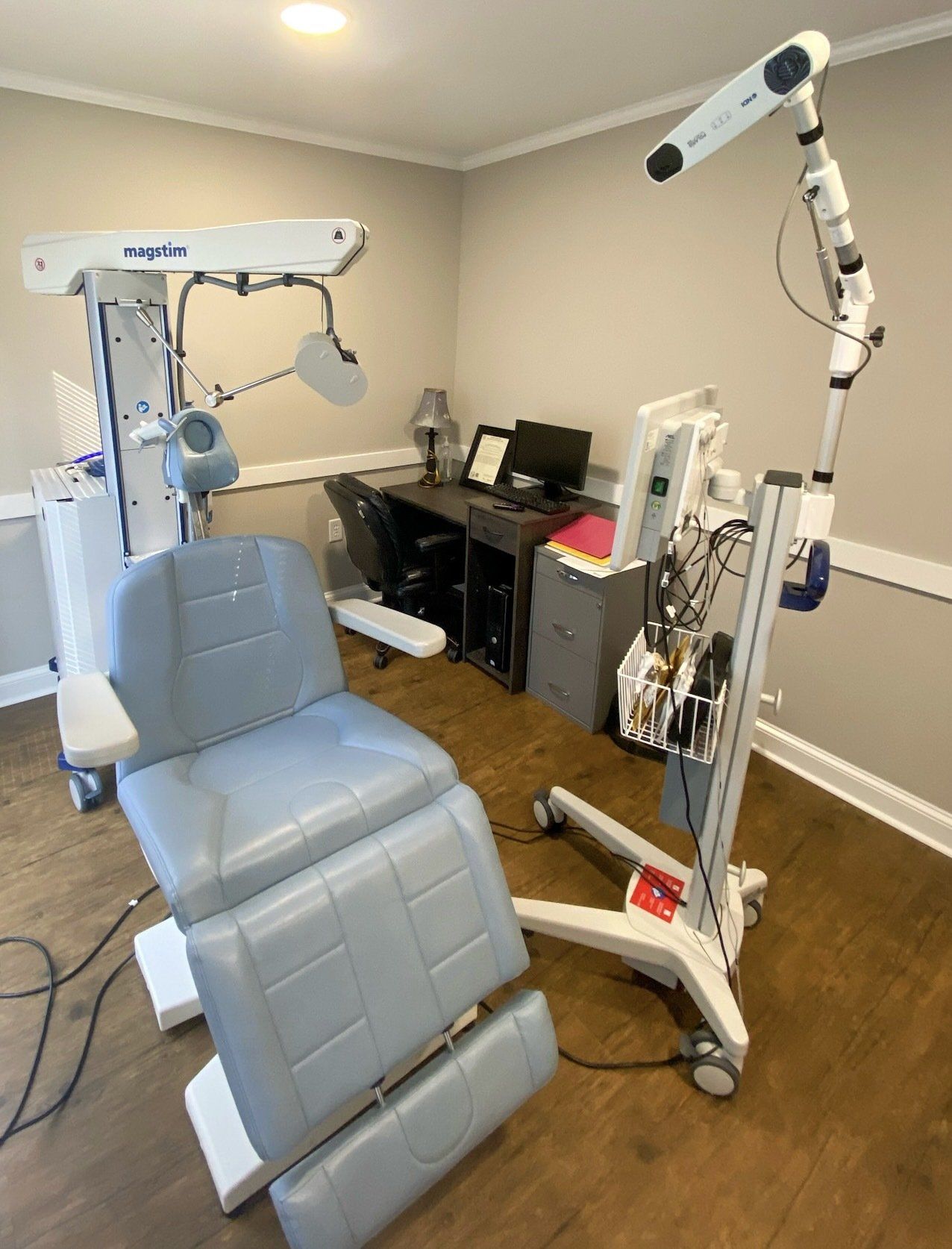
Your first session is the longest, usually about an hour, because it sets up every treatment that follows. This visit is called mapping. Its goal is to find the exact spot on your head to treat and the right strength of magnetic pulse for your brain.
Here is how mapping works, based on Mayo Clinic's overview of the procedure:
- You sit in a reclining chair and wear earplugs.
- A magnetic coil rests against your head and delivers short pulses, which feel like tapping and sound like clicking.
- The coil moves until the pulses make the fingers or thumb on the opposite hand twitch slightly.
- Strong and weak pulses alternate to find your "motor threshold," the energy level needed to produce that twitch.
- Those measurements are recorded, so later sessions start at your exact position and dose without repeating the process.
The finger twitch only happens during mapping. Your actual treatment spot sits over the part of the brain that helps regulate mood, in a different spot from where the twitch is found.
What Does a Typical TMS Session Feel Like?
A typical session feels like a steady tapping on your scalp while you sit awake and relaxed in a comfortable chair. The machine runs in cycles of a few seconds of rapid clicking followed by a pause. No anesthesia or sedation is involved, and you can talk, listen, or simply rest.
How long the stimulation lasts depends on the protocol your physician prescribes. Standard sessions run about 20 minutes, and some newer protocols take only a few minutes. Either way, visits are short enough to fit around a workday.
According to the National Institute of Mental Health, the most common side effects are:
- Discomfort on the scalp where the coil sits
- Tingling or twitching of the scalp, jaw, or face muscles during treatment
- Mild headaches or brief lightheadedness
Headaches tend to be brief and often ease as treatment continues. Seizures are possible but rare, and NIMH notes the risk is low when expert guidelines are followed. Because there is no sedation, you can drive yourself, return to work, and carry on with your day right after each session.
How Long Is a Full TMS Treatment Schedule?
A full course of TMS usually includes about 30 to 37 sessions, given several days a week over roughly six to ten weeks. The
NIMH describes a typical course as daily sessions five days a week for four to six weeks, and schedules vary by protocol. Your physician sets your exact plan at the consultation.
Results build gradually. Many people notice some change within the first two weeks. Others do not feel a difference until later in the course, which is normal and not a sign that treatment has failed. Completing the full schedule gives TMS its full opportunity to work.
Your TMS treatment timeline
- 30 to 37 sessions in a typical course
- 6 to 10 weeks, roughly
- Several sessions per week
-
Consultation Before treatment begins
History review, forms, symptom screening, and insurance questions.
-
Prior authorization Between consultation and first session
We submit your records to your insurer. Timing varies by plan.
-
Mapping session Session one
Coil positioning and dose setting, about an hour.
-
Treatment sessions Several days a week for the rest of the course
Short stimulation sessions with no recovery time.
Results build gradually. Many people notice some change within the first two weeks. Others do not feel a difference until later in the course, which is normal and not a sign that treatment has failed.
How Can You Prepare for Your TMS Appointments?

A little preparation keeps each session comfortable and on schedule. Before your appointments:
- Wear comfortable clothing and leave jewelry and other metal items at home.
- Tell your provider about every medication you take, since some can affect how your brain responds to treatment.
- Avoid alcohol and recreational drugs during your course of treatment.
- Arrive well rested and hydrated.
- If a medication is missing from your checklist, bring the bottle or a photo of the label.
- Write down questions as they come up so you can ask them at your next visit.
Our office sees patients by appointment Tuesday through Friday, 8:30 AM to 6 PM. Choosing a time slot you can keep week after week makes the schedule much easier to stick with. If you are still deciding whether TMS is right for your depression, our page on
TMS treatment for depression covers how it targets mood-related brain activity.
Start With a Free TMS Consultation in Greenville
If depression has not lifted with medication or therapy, a conversation about TMS costs nothing and commits you to nothing.
Is TMS the same as ECT?
No. TMS uses magnetic pulses, requires no anesthesia or sedation, and does not induce a seizure. ECT is given under anesthesia and works by producing a controlled seizure. Our comparison of TMS vs. ECT for depression covers how the two differ in recovery time and side effects.
What conditions is TMS FDA-cleared to treat?
TMS is FDA-cleared for major depressive disorder and obsessive-compulsive disorder. It is most often used for depression that has not improved enough with antidepressants and talk therapy. Your physician will confirm at your consultation whether your diagnosis and treatment history make you a candidate.
Can I keep working or going to class during TMS?
Yes. TMS is an outpatient treatment with no downtime, so most people schedule sessions around their regular day. You remain alert throughout and can drive afterward. Some people prefer a ride home after the first session just to see how they feel.
Is an online screening the same as a diagnosis?
No. Tools like the PHQ-9 help you put words and a severity score to what you are feeling, which is useful to bring to your consultation. A diagnosis and treatment plan come from a clinician who reviews your full history.
Our Helpful Links
Schedule a Consultation
Get help with depression today! It's important to know that you are not alone.